HOMILY FOR THE 24th SUNDAY IN ORDINARY TIME, September 12, 2010:
After reading the story of the Prodigal Son, a Sunday school teacher asked her kids, “At the end of the story who ended up in the worst situation? The younger or the older brother?” One of the kids shot up his hand and answered, “Neither one. It was the fattened calf.”
We heard in our Gospel today, “There will be more joy in heaven over one sinner who repents than over 99 righteous people who have no need of repentance.” Has anyone noticed that no one sins any more? Do you know many people who would call themselves a sinner? Acknowledge the place of sin in their lives and the need for God’s mercy? It really seems to have gone out of style. We’re all now “good people” who do “good things.” “I haven’t killed anyone,” they say, as though that were the only standard. Thirty years ago, confession lines were very long every Saturday as people had a clearer understanding of their need to be reconciled to God through Confession, and wouldn’t imagine receiving the Eucharist without having first asked God for the forgiveness of their sins. Today, confessions are more likely to last about 30 minutes each week and most priests bring a book with them to stay occupied for that half hour.
And yet, our Scriptures speak so profoundly about the central reason for Jesus’ coming to us – to save sinners, to reconcile us. The prayer of absolution that the priest says during confession begins with those very words, “God, the Father of mercies…has reconciled the world to Himself and sent the Holy Spirit among us for the forgiveness of sins.” And, the whole parable of the Prodigal Son that we have before us today is Jesus telling us of our need for repentance and reconciliation and God’s mercy to us when we seek it. And yet, so many of us today do not seek out this gift of healing and wholeness.
Why? My experience tells me that we are, as a whole, afraid of this sacrament. We’re afraid because of bad past experiences; we’re afraid because we don’t know what to say; we’re afraid because we don’t know what the priest will say to us. Confession is today perhaps the most misunderstood and under -utilized sacrament in the Church.
I invite you today to cast away all of your prior misconceptions about Confession and think about this sacrament in a new light. What is reconciliation really about? First of all, it is actually less about you and your sin and more about God and His mercy. Our fears are often about our sins and about what we will say, or what the priest will say to us. The reality is that reconciliation is really about God and about how loving and forgiving and merciful He is. It is about a forgiving Father who can’t wait to offer His mercy to His children who come and ask for it – like the Prodigal Son. God wants to offer to us love and forgiveness, healing and joy. God can’t wait to forgive us, to free us from sin.
Part of the problem is that we’ve come to accept the world as it is. We live today in a world of broken relationships. There isn’t one among us here who hasn’t been touched by divorce, for example – whether directly in our own families, or extended family or friends. There isn’t one of us here who doesn’t have a broken relationship somewhere in our lives – a friendship destroyed, a misunderstanding overblown, regretted words spoken and never taken back. The myth of the world is that we have to accept that brokenness and can never achieve healing. Jesus tells us something different and gives us the opportunity – in a grace-filled encounter with him in the Sacrament of Reconciliation to restore, heal and reconcile the broken relationships in our lives.
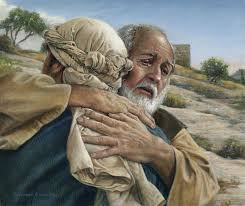
And that is what the parable of the Prodigal Son is all about. It is a story of broken relationships. The younger son has severed the relationship with his father in the worst way. He comes to recognize his wrong actions and wants nothing more than to be accepted again into his father’s household – not in the status he had before, but even just as a lowly servant. That’s supposed to be us – recognizing our sin, approaching our God asking to simply be allowed to remain a member of His household; of His family. And, what is the father’s reaction to the younger son? He is overjoyed at the son’s return. He says, “Now we must celebrate…your brother was…lost and has been found.” And the real power is that Jesus tells us that God will deal with us in the same way.
The merciful, loving heart of Jesus, the Good Shepherd, is the merciful, loving heart of God our heavenly Father. His mercy tirelessly seeks out each sinner and when we respond there is happiness and rejoicing in heaven. To every sinner, in other words, to all of us, I say as simply as I can: Your sin is not the big deal you think it is; the big deal is your return to the merciful love of God. Trust in His mercy, not in your sin.
As we heard from St. Paul, “This saying is trustworthy and deserves full acceptance: Christ Jesus came into the world to save sinners.” Let us approach Him and ask that He take away all that is keeping us from the grace of forgiveness.
May God give you peace.
The mosque controversy: We are not at war with Islam; we are at war with terrorists
FT NOTE: Fr. Daly says it well.
By Father Peter J. Daly
September 8th, 2010 | Catholic News Service
There is a mosque in my town, located less than a mile from our parish church. Its members are good neighbors; peaceful, hard-working and patriotic.
I have a cordial relationship with the local imam (leader). He is also a physician. We serve on the board of our community hospital together. I see him at meetings several times a month. He is a gentleman and a friend.
We have exchanged gifts. I have a set of Muslim prayer beads and a Quran, the Islamic holy book, which he gave me. He has a rosary and a Bible that I gave him.
Our faith communities live in peace.
After Sept. 11, 2001, the women of our communities started a group called Daughters of Abraham to foster dialogue between Christians, Muslims and Jews, the three Abrahamic faiths.
Catholics who are opposed to the building of mosques in New York City and elsewhere should recall our own troubled arrival on the shores of the United States.
In the 19th century, angry mobs burned Catholic churches in major cities throughout the Northeast, including New York. People accused Catholics then of the same things they are saying about Muslims today: They said we were loyal to a foreign power (the pope). They said we were seeking to institute Catholicism as the official religion of the nation and establish our law. They said we were disruptive of the public peace.
In the 1830s and 1840s, the Know Nothing party spread vile rumors about Catholics, inciting mobs to burn Catholic churches and convents.
In 1834, a Know Nothing mob burned the Ursuline convent in Charlestown, Mass. The local police and volunteer fire brigade looked on, giving tacit approval. The nuns and their students were forced to flee for their lives into the woods.
After the fire, the local bishop, considering the failure of the police to stop the arson as governmental approval, made application to the Commonwealth of Massachusetts for reimbursement.
A state legislature commission responded, saying “that Catholics, acknowledging as they do, the supremacy of a foreign power, could not claim under our government the protection as citizens of the commonwealth.”
In the 1850s, the New York papers editorialized against the building of St. Patrick’s Cathedral on Fifth Avenue. It offended their sensitivities.
After the Civil War, the American Protective Association spread throughout the Midwest. Formed in Iowa in 1887, it had thousands of members. They were required to swear an oath not to hire Catholics or aid in the building of any Catholic institution or support any Catholic for public office.
As such, Catholics above all should support the religious freedom of Muslims. We have been where they are today.
And Catholics should not buy into this argument about “sensitivity.” They made the same argument about our churches once. Our mere presence offended others.
If Muslims cannot build a mosque on their private property two blocks from ground zero, then where can they build it so they don’t offend? Is five blocks away enough? How about New Jersey?
The clear implication of this sensitivity argument is that all Muslims are somehow responsible for the atrocities of Sept. 11. This is absurd.
We are not at war with Islam; we are at war with terrorists.
I do not want to be made to answer for the behavior of the billion Catholics around the world. Should Catholics be labeled terrorists because some bomb-throwing member of the IRA uses our religion as a cover?
Sensitivity is not mentioned in the U.S. Constitution; religious liberty is.
Catholics who oppose the building of the mosque near ground zero may have forgotten our own history. In view of our past, we should be the strongest supporters of religious liberty.
Father Peter J. Daly is a pastor in Maryland and writes a column for Catholic News Service.
By Father Peter J. Daly
September 8th, 2010 | Catholic News Service
I have a cordial relationship with the local imam (leader). He is also a physician. We serve on the board of our community hospital together. I see him at meetings several times a month. He is a gentleman and a friend.
We have exchanged gifts. I have a set of Muslim prayer beads and a Quran, the Islamic holy book, which he gave me. He has a rosary and a Bible that I gave him.
Our faith communities live in peace.
After Sept. 11, 2001, the women of our communities started a group called Daughters of Abraham to foster dialogue between Christians, Muslims and Jews, the three Abrahamic faiths.
Catholics who are opposed to the building of mosques in New York City and elsewhere should recall our own troubled arrival on the shores of the United States.
In the 19th century, angry mobs burned Catholic churches in major cities throughout the Northeast, including New York. People accused Catholics then of the same things they are saying about Muslims today: They said we were loyal to a foreign power (the pope). They said we were seeking to institute Catholicism as the official religion of the nation and establish our law. They said we were disruptive of the public peace.
In the 1830s and 1840s, the Know Nothing party spread vile rumors about Catholics, inciting mobs to burn Catholic churches and convents.
In 1834, a Know Nothing mob burned the Ursuline convent in Charlestown, Mass. The local police and volunteer fire brigade looked on, giving tacit approval. The nuns and their students were forced to flee for their lives into the woods.
After the fire, the local bishop, considering the failure of the police to stop the arson as governmental approval, made application to the Commonwealth of Massachusetts for reimbursement.
A state legislature commission responded, saying “that Catholics, acknowledging as they do, the supremacy of a foreign power, could not claim under our government the protection as citizens of the commonwealth.”
In the 1850s, the New York papers editorialized against the building of St. Patrick’s Cathedral on Fifth Avenue. It offended their sensitivities.
After the Civil War, the American Protective Association spread throughout the Midwest. Formed in Iowa in 1887, it had thousands of members. They were required to swear an oath not to hire Catholics or aid in the building of any Catholic institution or support any Catholic for public office.
As such, Catholics above all should support the religious freedom of Muslims. We have been where they are today.
And Catholics should not buy into this argument about “sensitivity.” They made the same argument about our churches once. Our mere presence offended others.
If Muslims cannot build a mosque on their private property two blocks from ground zero, then where can they build it so they don’t offend? Is five blocks away enough? How about New Jersey?
The clear implication of this sensitivity argument is that all Muslims are somehow responsible for the atrocities of Sept. 11. This is absurd.
We are not at war with Islam; we are at war with terrorists.
I do not want to be made to answer for the behavior of the billion Catholics around the world. Should Catholics be labeled terrorists because some bomb-throwing member of the IRA uses our religion as a cover?
Sensitivity is not mentioned in the U.S. Constitution; religious liberty is.
Catholics who oppose the building of the mosque near ground zero may have forgotten our own history. In view of our past, we should be the strongest supporters of religious liberty.
Father Peter J. Daly is a pastor in Maryland and writes a column for Catholic News Service.
Subscribe to:
Posts (Atom)

